When your ATCO Gas bill arrives after a Lloydminster January cold snap, you know exactly how much those drafty windows are costing you. Sitting on the Alberta-Saskatchewan border means your home faces some of Canada’s most extreme temperature swings—from -40°C winter nights to +35°C summer afternoons. Standard blinds simply cannot handle that 75-degree annual temperature range, leaving homeowners in College Park, Parkview, and Lakeside searching for real solutions.
Key Takeaways:
- Cellular shades reduce heat loss through windows by up to 40% in cold climates (Source: Natural Resources Canada, 2022)
- Lloydminster’s unique border position creates specific energy challenges requiring superior insulation
- Double and triple-cell honeycomb blinds outperform single-cell options by 15-20% in extreme cold (Source: Efficient Windows Collaborative, 2023)
- Proper installation matters as much as product selection for maximum energy savings
Why Lloydminster Homes Lose Heat Through Windows
Your windows are the weakest thermal link in your home’s envelope. In a typical Lloydminster bungalow—whether it’s a 1960s mid-century build in Parkview or a newer ranch-style home near Bud Miller All Seasons Park—windows account for 25-30% of residential heating energy use (Source: U.S. Department of Energy, 2023). When temperatures plunge and SaskPower customers see their electric baseboards working overtime, those single-pane or older double-pane windows become expensive holes in your walls.
The Border City Climate Challenge
Lloydminster experiences what meteorologists call a humid continental climate with extreme seasonal variation. Your home near the Lloydminster Border Markers faces the same prairie winds that sweep across both provinces, creating unique pressure differentials that drive cold air infiltration around window frames. Standard roller blinds or aluminum mini-blinds do almost nothing to combat this heat loss—they simply hang there while your furnace runs continuously.
How Heat Escapes Your Windows
Heat transfers through your windows in three ways: conduction through the glass, convection from air movement, and radiation. Cellular shades address all three mechanisms simultaneously, which is why they outperform every other window covering option for Lloydminster’s extreme climate. The trapped air pockets inside each honeycomb cell create a thermal barrier that standard blinds cannot match.
How Cellular Shades Create Thermal Protection
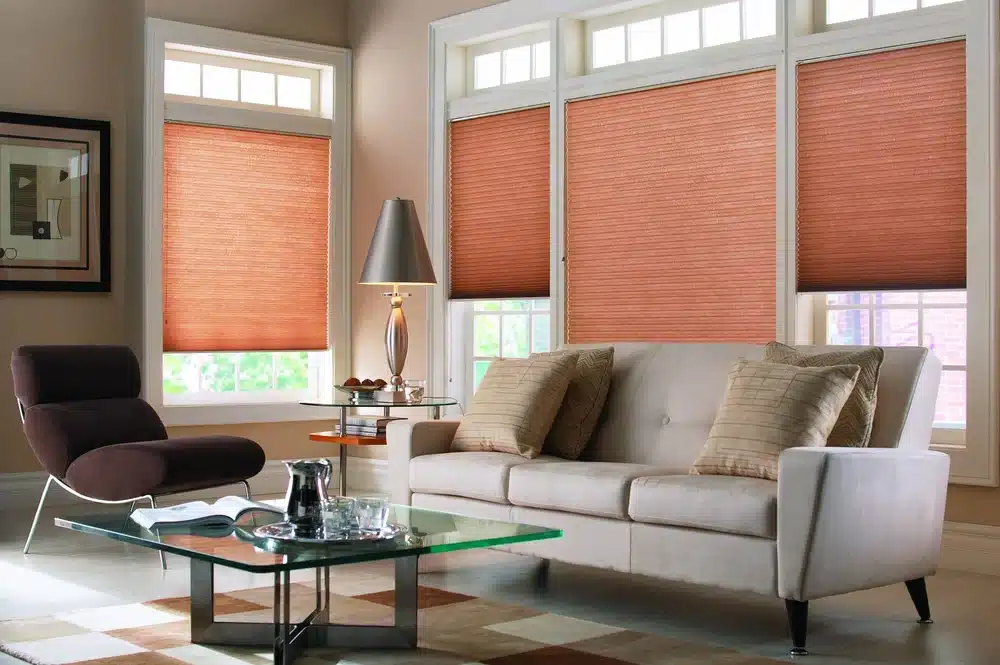
The honeycomb design of cellular shades isn’t just aesthetic—it’s engineering. Each cell traps a pocket of still air that acts as insulation, similar to how double-pane windows use an air gap between glass layers. For your Lloydminster home, this means creating an additional insulating layer that your existing windows desperately need.
Single-Cell vs. Double-Cell vs. Triple-Cell Options
The number of cells in your honeycomb blinds directly impacts their insulating value:
| Cell Configuration | R-Value Range | Best Application | Recommended For |
|---|---|---|---|
| Single-Cell | R-2 to R-3 | Mild climates, light control | South-facing windows, secondary rooms |
| Double-Cell | R-3 to R-5 | Cold climates, energy savings | Most Lloydminster homes |
| Triple-Cell | R-5 to R-7 | Extreme cold, maximum insulation | North-facing windows, older bungalows |
For context, a typical double-pane window has an R-value around R-2, meaning double-cell cellular shades can effectively double your window’s insulating capacity (Source: Efficient Windows Collaborative, 2023). In a College Park bungalow with original 1970s windows, this improvement translates directly to lower ATCO Gas bills.
Cell Size and Pleat Depth Matter
Larger cells (typically 3/4-inch or 1-inch) trap more air and provide better insulation than smaller 3/8-inch cells. However, the visual proportion matters too—a grand picture window in a modern Lakeside build looks best with larger pleats, while smaller bathroom windows in older Parkview homes often suit compact cells. Your installer should help you balance thermal performance with your home’s architectural character.
Real Energy Savings for Lloydminster Homeowners
Let’s talk numbers that matter to your household budget. According to Natural Resources Canada, properly installed cellular shades reduce heat loss through windows by up to 40% during heating season (Source: Natural Resources Canada, 2022). For a typical 1,400 square foot Lloydminster bungalow spending $2,800 annually on natural gas heating, that window-specific improvement can translate to $200-350 in annual savings.
Summer Cooling Benefits
Your cellular shades work year-round. During Lloydminster’s hot summers, the same insulating properties that trap heat inside during winter keep solar heat outside. The U.S. Department of Energy reports that cellular shades can reduce unwanted solar heat gain by up to 60% when installed with a tight fit (Source: U.S. Department of Energy, 2023). If you’re running air conditioning or relying on SaskPower for electric fans, this solar rejection keeps your home comfortable without the energy penalty.
Why Installation Quality Determines Your Savings
Here’s what big-box stores won’t tell you: a cellular shade’s energy performance drops dramatically with improper installation. Gaps at the sides, top, or bottom create convection pathways that bypass the insulating cells entirely. Professional inside-mount installation with proper side channels can improve thermal performance by an additional 10-15% compared to loose-fit installations (Source: Lawrence Berkeley National Laboratory, 2021). Your Lloydminster home deserves that precision.
“The difference between a cellular shade that saves energy and one that just looks nice comes down to fit. In prairie homes facing -40°C winters, every millimeter of gap matters. We measure twice, install once, and guarantee the thermal seal.”
Choosing the Right Cellular Shades for Your Home Style
Lloydminster’s housing stock presents unique aesthetic considerations. The community’s blend of mid-century bungalows, modern builds, and ranch-style homes means one product line cannot serve every architectural need. Your cellular shades should complement your home’s character while delivering maximum energy efficiency.
Options for Mid-Century Bungalows
If you own a 1950s-1970s bungalow in Parkview or the neighborhoods near Bud Miller All Seasons Park, you’re likely dealing with larger picture windows and lower ceilings. Consider these features:
- Top-down/bottom-up operation for privacy without sacrificing natural light
- Neutral tones (warm whites, soft grays) that complement original wood trim
- Cordless lift systems for clean sightlines and child safety
- Room-darkening options for bedrooms where streetlights affect sleep
Options for Modern and Ranch-Style Homes
Newer construction in Lakeside and College Park often features larger windows, open floor plans, and contemporary finishes. Your cellular shade selection might include:
- Motorized operation with smart home integration for hard-to-reach windows
- Light-filtering fabrics that maintain views while reducing glare
- Bold accent colors that complement modern interior design
- Specialty shapes for arched or angled windows common in newer builds
Color Selection and Light Control
Your fabric choice affects both aesthetics and performance. Darker colors absorb more solar heat (beneficial in winter, problematic in summer), while lighter colors reflect heat year-round. For most Lloydminster homes facing our extreme temperature swings, medium-tone fabrics with light-filtering properties offer the best year-round balance. Your in-home consultation allows you to see fabric samples against your actual walls and lighting conditions.
Why Lloydminster Homeowners Trust Local Installation
Online ordering might seem convenient, but cellular shades are precision products. The thermal performance you’re paying for depends entirely on accurate measurement and professional installation. Here’s what local expertise delivers:
- Climate-specific recommendations based on experience with Lloydminster’s temperature extremes
- Knowledge of local building styles from decades of installations across College Park, Parkview, and Lakeside
- Warranty service that doesn’t require shipping products across the country
- Same-week consultation availability rather than weeks-long scheduling delays
When you’re investing in energy-efficient window coverings to combat your ATCO Gas and SaskPower bills, you need installers who understand what -40°C actually feels like against a north-facing window. Schedule your free in-home cellular shade consultation today and discover the difference local expertise makes.
Your Next Step Toward Lower Energy Bills
Lloydminster’s extreme climate demands more from your window treatments than other Canadian cities require. Cellular shades—properly selected and professionally installed—deliver measurable energy savings that you’ll see on every ATCO Gas and SaskPower bill. Whether you’re updating a vintage bungalow in Parkview, modernizing a family home in College Park, or finishing a new build near Lakeside, insulated shades provide the thermal protection your windows need.
Your free in-home consultation includes precise measurements, fabric samples matched to your décor, and a detailed quote with no obligation. We’ll evaluate your windows, discuss your energy goals, and recommend solutions that fit both your home’s style and your household budget. Schedule your free in-home cellular shade consultation today and start saving on your next heating bill.
Frequently Asked Questions
How much can cellular shades reduce my heating bill in Lloydminster?
Most Lloydminster homeowners see 10-15% reductions in overall heating costs after installing quality cellular shades on all windows. For a home spending $2,800 annually on ATCO Gas heating, this typically means $280-420 in savings per year. Homes with older single-pane windows or significant north-facing glass often see even greater improvements, sometimes reaching 20% heating cost reductions when combined with proper weatherstripping.
Do cellular shades work on the large picture windows common in Lloydminster bungalows?
Yes, cellular shades are manufactured in widths up to 144 inches, accommodating the oversized picture windows found in many College Park and Parkview bungalows. For windows exceeding standard widths, two shades can be mounted side-by-side on a shared headrail, maintaining a seamless appearance while preserving full thermal performance. Motorized lift options are particularly popular for these large installations since manual operation becomes cumbersome beyond 60-inch widths.
What’s the lifespan of cellular shades in extreme prairie climates?
Quality cellular shades typically last 15-20 years in Lloydminster homes when properly maintained. The main wear factors are UV exposure (which fades fabrics over time) and mechanical operation (raising and lowering). Choosing UV-resistant fabrics and cordless or motorized lift systems extends lifespan significantly. Most manufacturers offer 5-7 year warranties on materials, with professional installers often providing additional labor guarantees for the first 2-3 years.
Can I install cellular shades myself to save money?
While DIY installation is technically possible, self-installed cellular shades typically underperform by 15-25% compared to professional installations due to measurement errors and improper mounting. The thermal benefits you’re paying for depend on achieving tight side gaps (under 1/8 inch) and proper headrail sealing—precision that requires specialized tools and experience. Given that professional installation typically adds only $30-50 per window, the energy savings from proper fit usually recover that cost within the first heating season.